Wednesday, December 2, 2009
Shopping for paint at the Russian equivalents of Home Depot & Costco/Walmart (?)
More mural planning workshops in St. Petersburg
Before meeting with the main mural group on Friday, we did two short workshops with all the students in the younger grades--mainly to understand their main interests for a mural that will be created primarily for them. At our workshop they shared the drawings they had done in response to a very general prompt by their teachers about what they'd like to see from their windows. I was admittedly a little concerned when I did not see any clear overall theme emerging from these drawings--but there was a rather interesting variety. Some of the imagery was more generalized or literal, things that students already see in their own homes and neighborhoods--the distinctive red tram that runs along the wide street in front of the school, an auto dealership across the way, a street vendor's cart. Other students had gravitated toward the more imaginative: especially wishing to see more "aquaparks" with water slides, zoos, and New Years decorations in their neighborhoods (in Russia, New Years is the big holiday where people decorate trees and exchange gifts). In the interior views of students' homes, there was an interesting profusion of pet cats wandering over all kinds of furniture and sleeping in windows; TV sets, computers and video games with the plugs prominently showing; and fanciful ceiling lamps. In the first group students simply talked through their ideas, and we spent a few minutes specifically discussing how we could incorporate images of animals in the mural. The second group made a new set of drawings, in response to the question of what they might want to see outside their windows that would improve the neighborhood. Since everything had to be translated twice (first Russian, then sign language), any sort of complex thematic discussion was difficult.
I left feeling excited by all the cute and playful drawings, but also with the hope that the older group, our core mural team, could come to a swift decision on a more specific approach to our theme. After our first planning workshops with this group (about 8 students in the upper grades, selected by teachers based on interest and artistic experience) it was apparent that it wouldn't be as easy as I had hoped. My last group in Krasnoyarsk had been immediately vocal from the start in taking ownership of everything from larger conceptual decisions to the minutia of practical things like photocopying and image research. This group, while all talented young artists and clearly interested in working on a project, was initially more reserved and quiet--not only in a literal sense, since many of them only communicate by sign language. I had come with a list of some of the main trends I pulled out from the younger kids' drawings, and examples of each, and thought maybe these group members could discuss amongst themselves and vote on which ideas seemed the strongest, and create some final sketches for the mural before we left for the day. It became apparent that I would have to guide the students a little more toward one idea, and that it was easier for them to work out their ideas by sketching than have a group discussion. We did not get a lot of finalized designs by the end of this workshop, but we did narrow things down to choosing 6 specific windows to make: a classroom window, a museum window, and a home/house window (looking inside) and a neighborhood window, faraway places window (such as NYC or Paris) and a fantasy land window (looking outside). The students wanted to sketch some ideas over the weekend for all of the windows on this list, and bring them in Monday to finalize the design.
I left feeling like we were not as far along as I would like to be, but at least were narrowing down the ideas. I realized that I would have to do a lot of the main design work on my own and come up with some very structured ways for the students to take part, but I did feel strongly that the ideas should come from them and not me. For this reason I felt comfortable incorporating an extra sketching/planning day before making any completely final drawings of what would go in each window. I did spend the weekend designing specific window frame shapes based on Russian folk art, which would be cut by a professional wood carver/sculptor, and arranging how they would be placed on the school hallway walls--I am now proud to say I am much more comfortable with creating architectural scale drawings in adobe illustrator, but am not about to pursue a career in architecture!
On Monday, we presented the specific window shapes to the students in the group and asked them to make even more finalized sketches for each one--each student picked one window to work on. There were a few new ideas the students brought up which we had to shoot down because of the need to focus the project. Unfortunately this second sketching session got cut short because most of the students were not let out of their after-lunch classes by teachers--a problem that Nastya would later resolve! At this session, the group began to gel and it was fun finding ways to communicate and connect with them despite the multiple language barriers--from writing down words in English and Russian, to learning a few key sign language gestures to accompany the smattering of art lesson-related Russian words I've picked up here: like "horasho"/"good" or "krasiva"/"beautiful." I also saw how engaged they become in their artwork, and how this is a wonderful form of expression for them.
After the workshop, I was still left with the assignment of putting hundreds of sketches and ideas into 6 small windows that need to be both engaging on their own, and cohesive as an entire installation--definitely a challenge from an artistic standpoint alone!
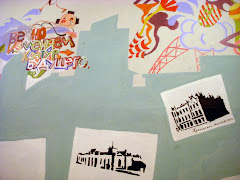
Public art site at the school...pre project!
We will install 6 different windows throughout this long hallway, plus an extra one for the project title.
I wrote the following project description for our promotional postcard:
This project [title in English and Russian to come soon!] builds upon a recurring theme in my own artwork: combining multiple views in one picture. The project will transform a corridor in the school through inserting painted windows on its walls. The "windows" will be made of wood with three-dimensional frames carved and decorated in the style of traditional Russian windows, alluding to the importance of historic preservation. Each window will show different interior or exterior scenes that reflect the responses of the children at the school when asked, "what would you like to see inside and outside your windows?" The windows will touch upon such themes as neighborhood and family life, the importance of learning, and the potential of imagination.
Public Art Presentation at the school
Sunday, November 29, 2009
First mural planning workshops in St. Petersburg
In St. Petersburg, I am doing a very different sort of project than in Krasnoyarsk, though it is also at a school for children (quite incidentally, the school is no. 33, while the Krasnoyarsk was no. 32!). The group I am working with will be younger, all students at the school, and all deaf or hearing impaired, as this is the school's specialty. They also are not as available for as many hours per day. As opposed to the last project, which was such a quick and intense experience,we have almost 3 weeks to do the project until the presentation day scheduled Dec 10--apparently this is longer than most ArtsLink residencies, though I am starting to realize this is not a lot of time!
On my first day of the project, Tuesday Nov 24, I gave a similar presentation on public art to the one I gave in Krasnoyarsk, but this was geared more towards a school-aged audience: much shorter, and less focused on the theme of Utopia and social issues, more focused on the simple idea that public art can make an environment better and create a sense of home. I focused less on street art, and more on community murals and projects at schools. I was coming into the project with the general theme of home, or the Russian house ("doma"); Nastya, the project manager working with me in St. Petersburg, had told me in advance that Russian folklore centered around magical spirits from the home is something that interests the school.
Immediately after the presentation the teachers and students began to discuss (excitedly, in Russian and sign language) ideas for how the project will be carried out. Surprisingly, everyone seemed to arrive pretty quickly at a main idea at this first meeting: to place different windows down a long school corridor, each showing some kind of view looking either inside or outside the students' homes and schools. I was immediately excited by this ideas as it relates to so much of my other artwork, including a mural proposal I had made for my old high school, as an assignment for a mural fellowship program, that inserted fake windows on the building's exterior.
The students who had attended my lecture, mostly upper grades (ages 12-16 or so) felt strongly that the younger students should have a say in the content being seen through the windows, but that the teachers would assemble a core group of older students to work with me on all aspects of the mural. The following day (Wed) I would not come into the school at all but the teachers in different classrooms would discuss this idea with students and collect sketches of their ideas, which I would then review Thursday. Friday would be my first day working with the core mural group, and hopefully that session would yield some final sketches. We spent the rest of the day touring the school and discussing project logistics.
On that same morning I had also met Masha, who runs an organization ArtTerra, which works with artists to design playful, imaginative interior spaces and playgrounds for children. We will be collaborating with her on this project mainly in utilizing her expertise designing whole spaces and working with 3-D materials. For example, she was very excited by the idea of creating actual window frames out of wood, and knows wood carvers who can create pretty elaborate designs for them.
More on the next workshops to come...
Subscribe to:
Posts (Atom)